
Reprinted with permission by George Huitema, the author, and the Bow Valley Calligraphy Guild, Calgary Alberta
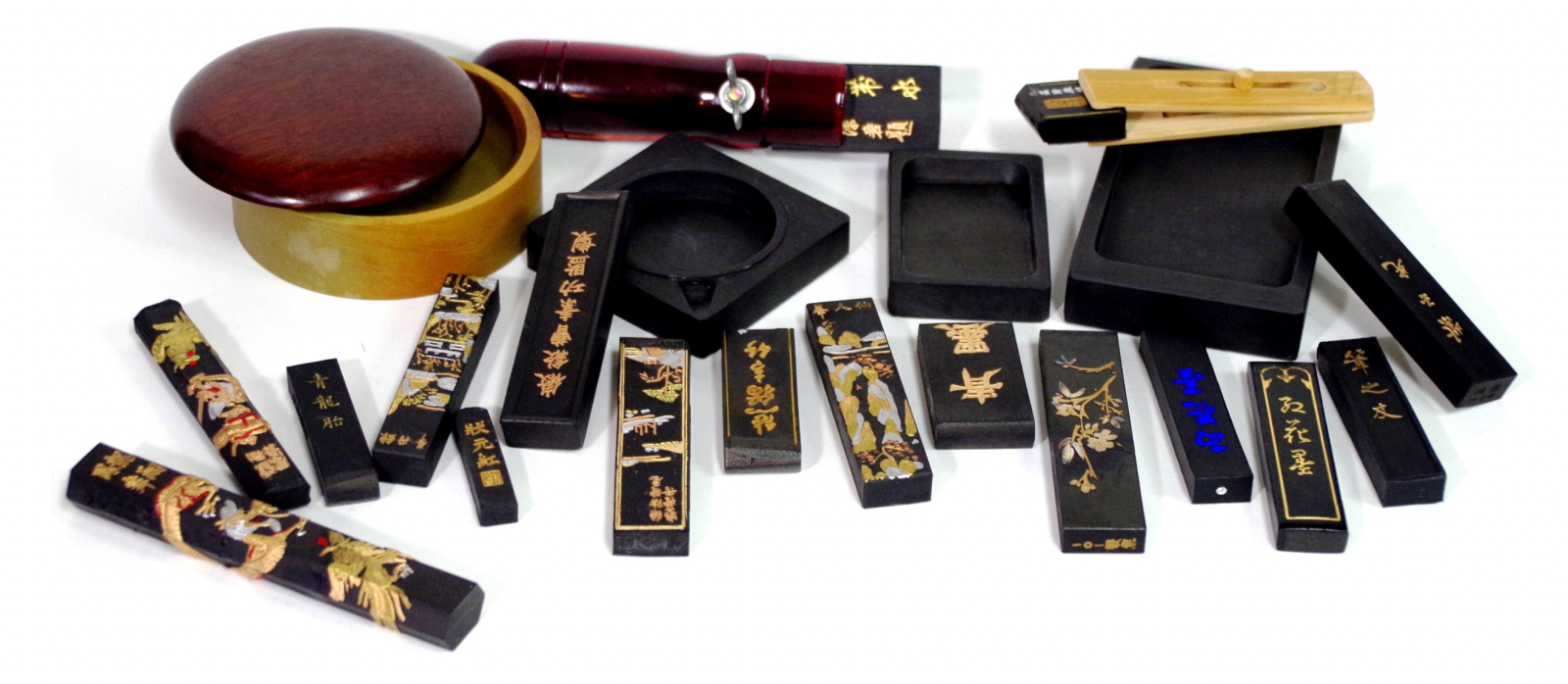
Stick inks and grinding stones. Clips for holding shorter pieces of stick ink are shown at back right, and back centre.
Sumi Ink Sticks
-
Ink sticks are Sumi ink in a solid form. To make liquid ink, the sticks are ground with water on a special stone. Traditionally used in East Asian calligraphy and painting, western calligraphers are also using the ink for lettering.
-
Chinese or Japanese. Chinese stick inks are usually blacker than Japanese inks which tend to be grayer. This is due to different kinds of soot being used in the manufacturing which produce subtle variations in ink colour.
-
They contain soot from pine and other plants, oils, perfume, and fish or bone glue. These ingredients are kneaded together, formed into sticks, and then left to dry. Sumi ink sticks mature over time, from one to five years or more, and can last for centuries.
-
Prices can range from a few dollars to $50 or more. Price is usually an indicator of quality, but not always. The best way to determine if an ink stick is good is to try it. The size of the stick is also a consideration. Check the dimensions before you buy it. I ordered an expensive stick and when it arrived it was very small (15 mm x 60 mm and 8 mm thick). The quality was excellent though.
-
To use, hold the stick vertically and grind the end with distilled water on a slate ink stone (Suzuri).
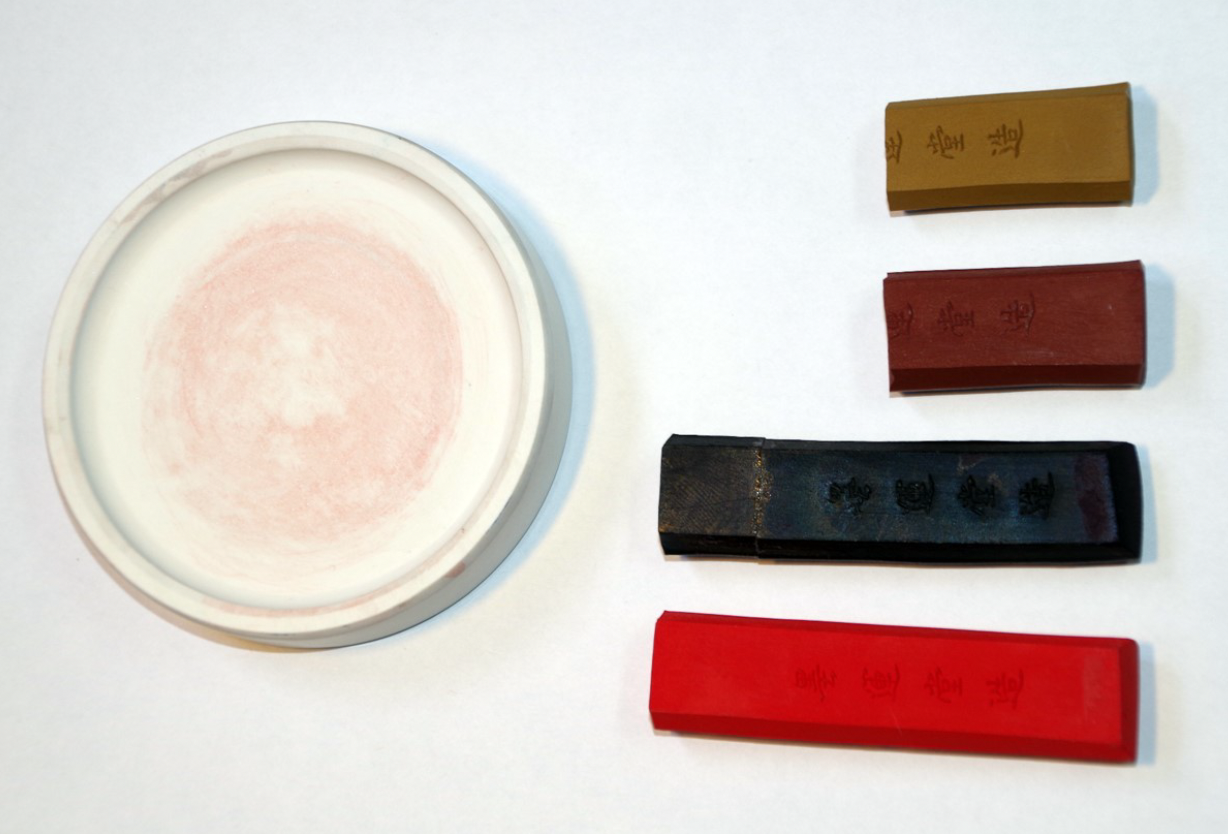
A gaken dish and coloured ink sticks
Coloured Ink Sticks
-
Chinese or Japanese. Some of the highly decorated sets of Chinese coloured ink sticks are used as gifts only, and are not suitable for making a workable ink.
-
They are made from high grade inorganic pigments combined with a binder of fish or bone glue.
-
The Japanese Boko-Undo sticks seem to be the best for making a rich ink.
-
Prices for coloured sticks range from $12 to $34US depending on the pigment.
-
To use, hold the stick vertically and grind the end with distilled water on a gaken dish, which is an unglazed round white ceramic dish.
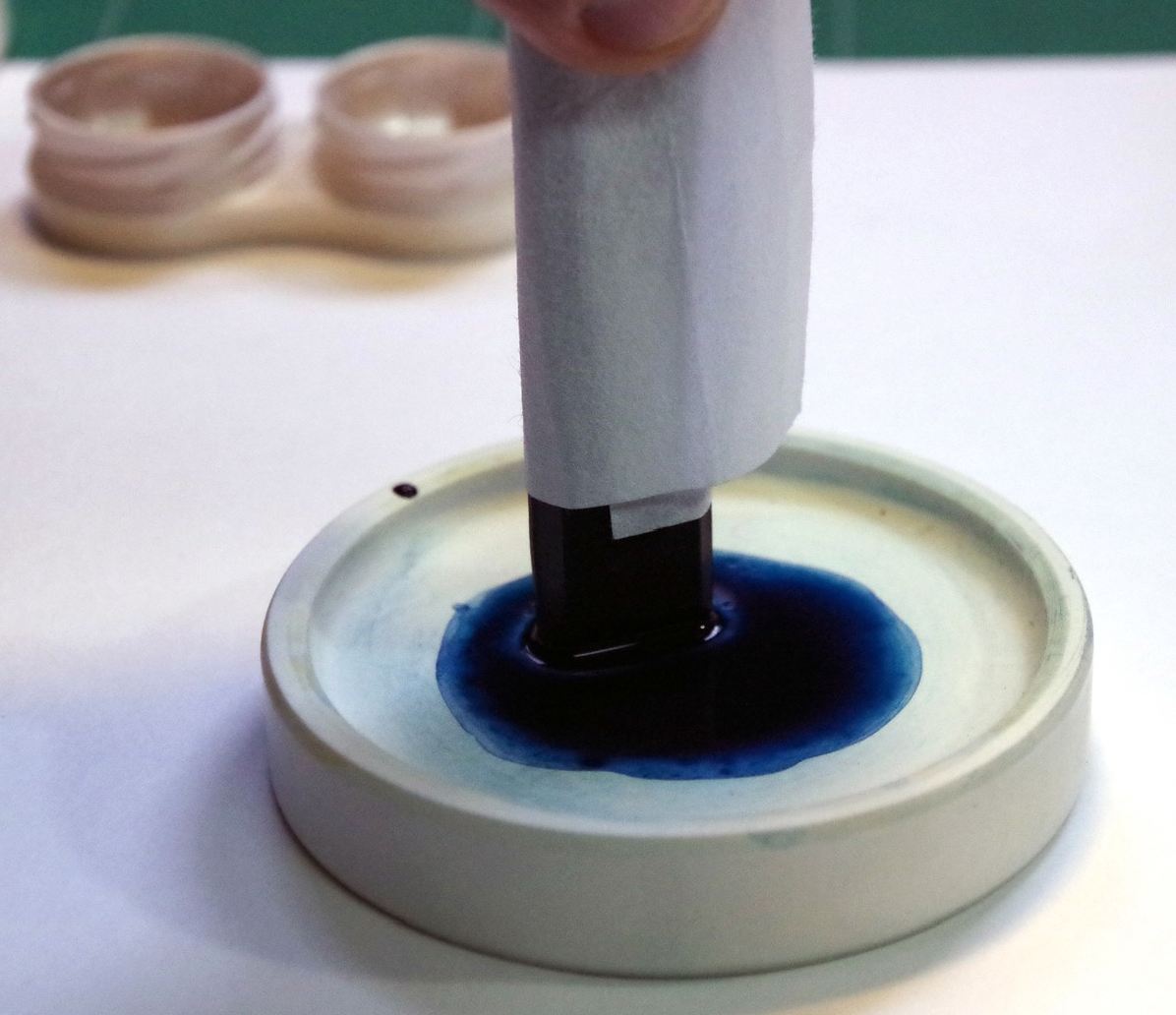
Grinding an indigo ink stick on a gaken dish
Advantages of Stick Ink
-
They have excellent archival properties, including lightfastness.
-
They are usually waterproof, depending on the stick or manufacturer, but this might take a few days of drying to achieve.
-
If ground properly, the small particle size produces a smooth ink.
-
The thickness of the ink is easily controlled.
-
The sticks are very portable. Only grind as much as you need for that day or project.
-
Preparation (rubbing/grinding) of the ink provides a time of quiet tranquillity and can be meditative.
-
Stick ink was used to produce the Saint John’s Bible, if that alone isn’t reason enough to try it!
Grinding the Ink Stick
-
Wrap the ink stick with rice paper to prevent contam-ination from the oils on your skin.
-
Add four or five drops of distilled water to the ink stone. Always try to use a good quality stone which should have a smooth surface.
-
Hold the stick perpendicular to the stone and rub lightly, going back and forth and in circular directions. The light touch gives finer pigment particles. Rub until you can drag the stick through it and the ink stays separated.
-
Add four more drops of water and repeat the process until you get the volume you want. Add a few more drops to get the ink to a desired thickness for writing.
-
Immediately after grinding, pat the ink stick on a cloth to dry it off and let it air dry for a few hours. If you leave the ink stick wet, it will absorb the moisture and then start flaking, thus damaging the stick. When you go to grind it again, the flakes will come off and will alter the particle size of the ground ink.
-
Transfer the ink with an eyedropper, pipette, or brush to a sealable container or palette. I use old contact lenses cases.
-
Immediately after use, clean the stone with water and an old tooth brush. Do not let the ink dry on the stone as it can damage it. Never use soap as it absorbs into the stone and will affect the ink the next time you grind.
-
Always grind coloured ink sticks on a gaken dish, or a slate ink stone that has not been used for black. The ink stones are porous and will absorb some of the black ink and muddy your colours.
-
Store ink sticks and stones in a dry place. A wooden box or a plastic container with a desiccant pack works well. Excess humidity can cause ink sticks to crack.
-
Watch some YouTube videos on how to grind your ink. There are many goods ones out there.
Using your Ground Ink
-
Use your ground ink in the same way as you would use gouache and other inks.
-
I load my nibs with a mixing brush.
-
Test it on paper and thin it if necessary with more distilled water. It is better to make a thick ink and then thin it, rather than grinding a thin ink.
-
You can use the last dregs of the ink for practice by thinning it with more distilled water.
-
Generally, ink will only last a few days before it goes bad and becomes stinky; however some inks last for a couple weeks. To extend the storage time, the mixed ink can be kept in the refrigerator.
References
-
Sumi by Christine Flint Sato, Letter Arts Review, volume 18:1, pages 3-11. This is a very good article on how the Sumi ink sticks are made.
-
Class notes from Reggie Ezell’s yearlong course: 26 Seeds – A Year to Grow, 2003.
-
Stick Inks, A Guide For Beginners by Kevin Williams, Postscript, February – March 2015 (Postcript is the journal publication of the Calligraphy Society of Victoria, Australia)
-
Boku-Undo Co., Ltd. website, www.boku-undo.co.jp